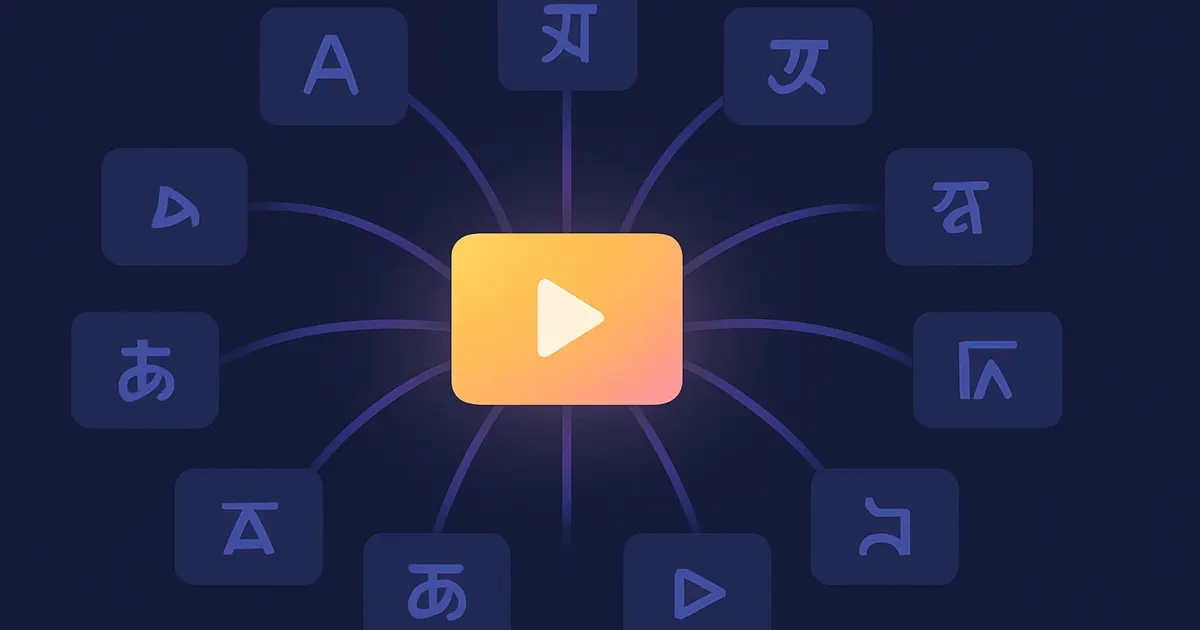
The cost of going global with video used to mean re-shooting, re-voicing, or re-cutting in every market. That bar dropped in 2026. Independent benchmarks now place leading AI dubbing tools at 95–98% translation accuracy on common language pairs, with per-minute costs down by roughly 90% compared to traditional studio dubbing.
The harder question is no longer whether to localize. It is how to set up a multilingual AI video editing workflow that scales without breaking your brand or your timelines. Here is a practical workflow that does exactly that, using Tellers.
The Bottleneck Is the Loop, Not the Translation
Translation has become a commodity. What still slows teams down is everything around it:
- Cutting the source video so it works across cultures, not just languages
- Generating voiceovers that match the original pacing
- Re-timing captions when the translated copy is longer or shorter
- Rendering per-platform versions for each language
- Pushing the right cut to the right region, on schedule
A single video can fan out into 30–40 deliverables once you multiply languages by platforms by aspect ratios. The translation is the easy part. The loop is the hard part.
A Practical Workflow
The workflow below assumes you have one master video and a list of target languages. Everything happens by chat inside the Tellers app.
1. Upload and transcribe the source
Drop the master cut into your Tellers account. The agent transcribes the audio, detects scene boundaries, and builds a searchable representation of the content. Only done once per master, automagically.
2. Translate the script
Ask the agent to translate the transcript into your target languages. For technical or branded copy, paste your glossary into the chat so the translation respects fixed terms. Treat the output as a strong first draft — a human linguist pass is still worth doing for high-stakes content.
3. Generate localized voiceovers
For each target language, ask the agent to generate a voiceover in a voice that fits the brand. Tellers orchestrates across multiple voice providers, so you can pick a neutral voice, a region-specific accent, or — with permission — a cloned voice modelled on the original speaker.
4. Re-time captions and on-screen text
Translated copy is rarely the same length as the source. German runs long; Mandarin runs short. The agent re-times subtitles to the new voiceover and adjusts on-screen text overlays so visual pacing still works.
5. Render per-language, per-platform variants
Once the localized master is approved, ask for the rest:
- 9:16 Reels, TikTok, and Shorts cuts in every target language
- 16:9 cuts for the website and YouTube
- 1:1 cuts for paid social
- Subtitle-only versions for languages where dubbing is not yet supported
Where This Pays Off
A few patterns hold up across teams using this workflow:
- Content teams publish a launch video in 8–10 languages on day one instead of staggered over weeks.
- Training and L&D teams localize onboarding modules without booking studio time per market.
- Media brands turn a single interview into platform-native cuts in every region they sell into.
- API customers trigger the workflow from a CMS or catalog — new master video in, fully localized deliverables out, no manual steps in between.
The constraint stops being production capacity. It becomes whether the source content is sharp enough to be worth multiplying.
Where to Keep a Human in the Loop
A few honest caveats. AI translation is strong on common language pairs and weaker on idioms, humour, regulated copy, and brand voice. Cloned voices need explicit permission and should be disclosed where local regulations require it. Lip sync for talking-head video is still imperfect across many languages — caption-only or voiceover-only output is often the safer choice for high-profile.
The pattern that works: ship a fast localized draft from the AI workflow, then have a native reviewer sign off before the variant goes live.
What is multilingual AI video editing?
A workflow that takes a single source video and produces localized versions — translated captions, dubbed voiceovers, and language-specific cuts — using AI for transcription, translation, and voice synthesis instead of re-recording.
How many languages can the workflow handle?
It depends on the underlying voice and translation models. Modern speech-to-text systems support 70+ input languages, and realtime translation models cover 13 output languages today. Caption-only localization works across more languages because it skips voice synthesis.
Will the original speaker's voice be preserved?
Voice cloning is available through several providers and can reproduce a speaker's tone across languages. Whether you should use it is a separate question — disclose AI-generated voice in regulated contexts and get the speaker's permission before cloning.
How accurate are translations for video?
Independent benchmarks in 2026 place leading AI dubbing tools at 95–98% translation accuracy on common language pairs. Idiomatic content, technical jargon, and humour still need a human pass before publishing.
Can a brand automate this across hundreds of videos?
Yes. The Tellers API lets you trigger the same localization workflow from a CMS or video catalog. A single source upload can fan out into versioned outputs per language and per platform.
Try It on One Video
Pick one master cut. Upload it. List the languages you need. Let the agent produce a draft set of localized variants and review them before they ship.
Open Tellers and start with one source. The first localized version takes minutes; the next ten cost less than that combined.