At Tellers, we care deeply about speed.
Not speed as a vanity benchmark.
Speed as a creative requirement.
When you work with an AI agent, the goal is not simply to automate a task and wait. The goal is to stay engaged in a creative loop: ask for something, see it happen, judge it, refine it, and keep moving. That is why Pruna AI has become one of our main partners.
Pruna started at Station F alongside Tellers. They first built their reputation around model optimisation: making models faster, cheaper, smaller, and more efficient. Today, they are also starting to train and release their own models, and those models are exactly the kind we love integrating into Tellers.
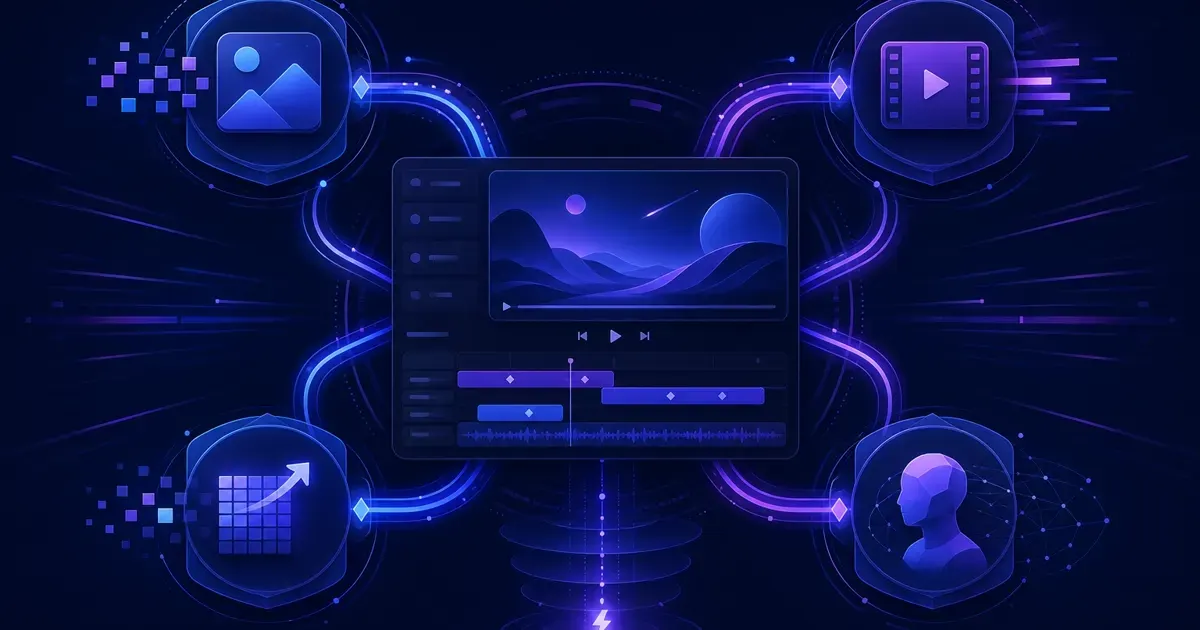
We have now integrated all of Pruna’s newly released model family into Tellers:
- P-Image
- P-Video
- P-Image-Upscale
- P-Video-Avatar
If you want to explore Pruna directly, visit Pruna AI.
Why Pruna Matters for Tellers
Tellers is an agentic video editor.
That means the product is not just a UI for calling models one by one. The Tellers agent can interpret your request, break a video into scenes, choose the right generation tools, search for references, create assets, revise outputs, and assemble everything into a coherent workflow.
But even with an agent doing the heavy lifting, the human creator still matters.
Creators need to stay in the flow.
That flow is where taste happens. It is where you decide whether a shot feels right, whether a visual is too generic, whether a scene needs more motion, whether the pacing works, or whether the whole concept should change direction. If generations take too long, users disengage. They stop exploring. They stop making fine-grained creative judgments.
That is why fast generative models matter so much.
For us, sub-second image generation and ultra-fast video generation are not just nice technical properties. They are what make agentic creation actually usable.
The Pruna Models We Integrated
Pruna’s new model family is especially compelling because it is designed around a combination that matters in real products: speed, cost efficiency, and good quality.
P-Image
P-Image is Pruna’s text-to-image model.
It is built for sub-second image generation at very low cost, while still delivering strong quality. This makes it a natural fit for agentic workflows inside Tellers, where the user may want many fast iterations before settling on a direction.
In practice, that means the Tellers agent can use P-Image to quickly explore concepts, generate visual options, or create assets that help shape a video before moving on to heavier operations.
P-Video
P-Video is Pruna’s fast video generation model.
It is built to generate high-quality video in seconds, which is exactly the kind of speed we want for interactive creation. In Tellers, this is powerful for rapidly testing scenes, building early drafts, and giving creators something visual to react to almost immediately.
A creator should not have to wait minutes just to decide that a scene is going in the wrong direction.
With fast video models you can are also the best tool to hone your video prompting skills. If you can get great results with smaller models you’ll do wonders with bigger models like seedance.
P-Image-Upscale
P-Image-Upscale is Pruna’s image upscaling model.
Fast upscaling matters more than it may seem. In real workflows, creators often move quickly through draft assets first, then decide what is worth refining. A fast, low-cost upscaler helps bridge that gap by letting the agent improve usable images without adding major delay or cost.
P-Video-Avatar
P-Video-Avatar is Pruna’s avatar-focused video model.
It is designed for fast, realistic talking-avatar generation. This opens up strong use cases for presentations, explainers, social content, product communication, and any workflow that benefits from a human-like speaking video without the cost and latency of a heavier pipeline.
Why Fast Models Work So Well With Agents
There is a common misconception in AI product design: if the agent is smart enough, latency matters less.
It’s true to some extent but at the same time new uses make latency matter even more.
As AI agents become more capable, speed is key, because users stop interacting with single outputs and start interacting with an ongoing process. You are no longer just prompting a model. You are collaborating with a system.
That collaboration only works well if the loop stays tight.
Fast models help the Tellers agent stay responsive. The agent can generate options, compare them, revise them, and keep the user involved throughout. That is especially important because creators do not only need execution. They need the ability to continuously make good taste judgments.
The agent can do the heavy lifting.
The human still provides direction, validation, and taste.
That balance is one of the core ideas behind Tellers.
Tellers Keeps You in the Flow
This is also why our in-house player matters so much.
The Tellers video player lets you see the agent’s modifications live, iterate with the agent while it works, and stop it if it is going in the wrong direction. That creates a much more interactive workflow than the traditional “submit, wait, inspect, repeat” pattern that dominates many AI tools today.
Fast models from providers like Pruna fit perfectly into that experience.
When generation is fast enough, the product feels alive.
When the product feels alive, creators stay engaged.
When creators stay engaged, they make better creative decisions.
That is a big part of how we think about product design at Tellers.
Speed at the Model Level, Speed at the Agent Level
Another important point is that speed in Tellers does not come only from the model itself.
It also comes from orchestration.
Tellers can parallelise calls to models. So even when a workflow uses a longer-running model such as Veo 3, the agent can generate all the required scenes of a video at once instead of waiting for them sequentially. It can also prepare start and end reference frames in advance to help preserve consistency across shots, even when the generation process is not inherently autoregressive across the whole sequence.
This means Tellers approaches speed on two levels:
- Fast underlying models, such as Pruna’s model family
- Fast agent orchestration, where the system plans and parallelises work intelligently
That combination is what makes agentic creation practical.
Why Cheap Models Matter Too
Price matters just as much as latency.
Many users arrive in Tellers wanting to explore, test, and learn. They are not always ready to spend heavily on premium generations from the start. They want to experiment safely, see what the agent can do, and build confidence.
That is why low-cost models are so important.
Pruna’s models are excellent defaults for many workflows because they let the Tellers agent do a lot without burning through credits too quickly. In many cases, they are cheap enough that users can create their first real videos using only the free tokens they receive on Tellers.
That is a much better onboarding experience than asking new users to spend heavily before they understand the product.
Cheap models are not just a cost optimisation.
They are a product adoption feature.
A Shared Belief: AI Should Be Fast Enough to Be Used
Pruna’s story resonates with us because it aligns with a belief we care about deeply: AI should not only be powerful. It should be efficient enough to fit real workflows.
Pruna built its name on optimisation, compression, and efficiency. Now, as they release their own models, they are bringing that philosophy directly into the generation layer.
That is exactly why we are excited to work with them.
At Tellers, we want creators to interact with AI the way developers interact with a great coding assistant: quickly, iteratively, and without constantly breaking their concentration. Fast images, fast videos, low-cost defaults, and responsive agent workflows all push in that same direction.
Pruna’s model family is a strong step toward that future.
Available Now in Tellers
We have integrated the full Pruna model family into Tellers:
- P-Image
- P-Video
- P-Image-Upscale
- P-Video-Avatar
We love these models because they embody a principle we believe in strongly: fast and affordable generative models are essential if you want creators to remain engaged while collaborating with AI agents.
If you want to learn more about Pruna, visit pruna.ai or explore their open-source work.
Who is Pruna AI?
Pruna AI is one of Tellers’ main partners. They started at Station F alongside Tellers and first became known for model optimisation: making AI models faster, cheaper, smaller, and more efficient. More recently, they have also started releasing their own models, which is what we integrate into Tellers.
Which Pruna models are available in Tellers?
Tellers integrates Pruna’s p-image, p-video, p-upscale, and p-avatar model family. In Pruna’s own naming, these are P-Image, P-Video, P-Image-Upscale, and P-Video-Avatar.
Why are fast generative models so important in Tellers?
Because Tellers is agentic. The AI agent can do the heavy lifting, but creators still need to stay engaged and in the flow while they review, guide, and refine the work. Fast models make that interaction feel alive instead of delayed.
What does Tellers do on top of the models?
Tellers is not just a model picker. The Tellers agent decides which model to use, when to use it, and how to combine multiple model calls into a coherent video workflow. It can also parallelise calls, prepare consistency references in advance, and let users review changes live in the Tellers player.
Why does cost matter as much as speed?
Cheap models are critical for experimentation. They let new users try ideas, iterate freely, and often create their first videos using only the free tokens available in Tellers. That makes them ideal default models for many early-stage workflows.
Can Tellers still use slower, higher-end models like Veo 3?
Yes. Tellers supports long-running models too. When a workflow needs them, the agent can parallelise generations across multiple scenes and prepare start and end frames in advance to maintain consistency across shots.
And if you want to experience these models inside an agentic video workflow, you can try them directly in Tellers.