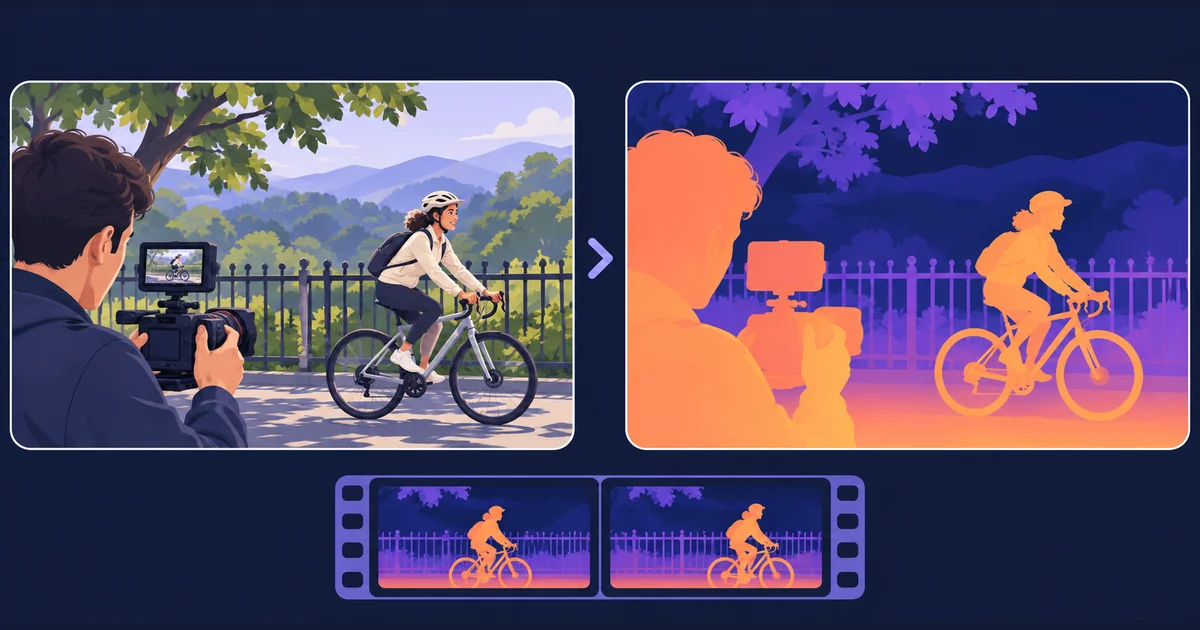
Apple’s Depth Pro 2 estimates how far things are from the camera, frame by frame. For video editors, the interesting part is that it processes nearby frames together. A depth effect needs to hold up when the subject moves, not just look right in a still.
In the paper submitted November 19, 2026, Peiyun Hu and colleagues describe a model that estimates depth in meters from a single camera. It takes photos, video files or a live feed. Apple’s side-by-side video comparisons show both the original footage and depth estimates. Watch the contours of moving objects to see what steadier depth looks like.
Why steadier depth matters in an edit
Say a cyclist passes in front of a title, with a fence and trees behind them. You want the letters to sit behind the cyclist and in front of the fence. A depth map gives you a way to place the title at a chosen distance and use nearer pixels to hide it. If the map changes erratically around the cyclist, the title can flicker through the silhouette. A steadier map gives you a better starting point for that composite.
Depth can also help you apply haze to distant scenery or separate a sharper foreground from a softened background. It estimates distance, so two objects at a similar depth may both be selected. Use a mask when the effect needs to follow one object specifically.
For a research test on your own footage, start with a short shot where a subject crosses the intended depth plane. The official inference repository can export a color preview and a sequence of 16-bit grayscale inverse-depth frames for compositing. The 16-bit export uses the first frame’s depth range: if something comes much closer later, its values can clip. Use the metric depth arrays when retaining those distances matters.
A note to the Apple research team
Depth Pro 2 is not integrated into Tellers yet. The model license permits research and excludes use in commercial products and services. The inference code has separate terms; downloading the code and checkpoints does not give us the rights to offer the model in our editor.
Shoutout to Peiyun Hu, the co-authors and the Apple research team for releasing the work. We’d love to showcase Depth Pro 2 as an Apple model in Tellers and show what creators can do with stable depth on a timeline. If there’s a way to license it for that use or collaborate on a showcase, we’d love to hear from you.
Frequently asked questions
Is Apple Depth Pro 2 available for research?
Yes. Apple makes the weights available under its Machine Learning Research Model License for noncommercial scientific research and academic development.
Is Apple Depth Pro 2 available for commercial use?
No. The published model license excludes commercial exploitation, product development and use in commercial products or services.
Is Depth Pro 2 open weight or open source?
The weights are public and downloadable, so it is open weight in that limited sense. The model is not open source: its license restricts use to research. Apple publishes the inference code under separate terms and does not include the training or evaluation code.
Where can I download Apple Depth Pro 2?
Start with Apple’s Hugging Face model page, which links the S, B, L and H+ checkpoints. Apple also provides Core ML packages for Apple silicon.
Where can I test Apple Depth Pro 2?
For a browser test, try the community Hugging Face Space. You can also run Apple’s local camera demo on an Apple silicon Mac or follow the repository’s instructions to process a photo or video.