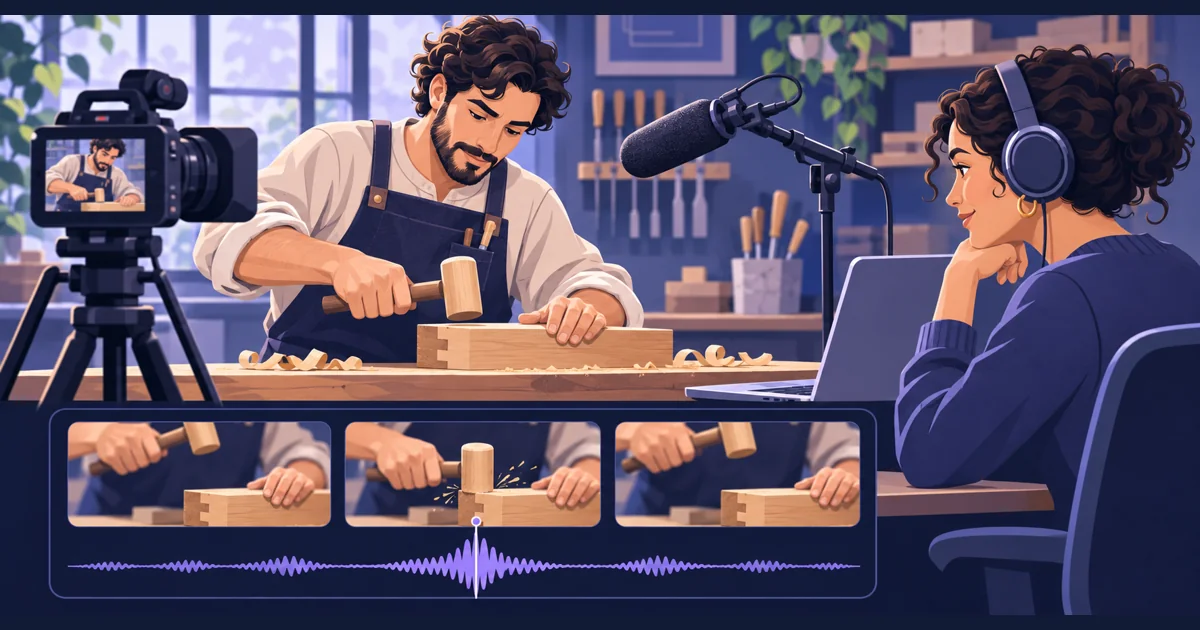
A shot can look useful and still be the wrong moment to cut to. The person may say “this one” while pointing somewhere else, a machine may stop before the explanation ends, or an off-camera laugh may change the meaning of a reaction.
That is why Tencent’s WeMM-Video is interesting for video editing. Its technical report, submitted on November 19, 2026, focuses on understanding pictures and sound together. The release is about analysing footage and answering questions about it, rather than generating new clips.
What Tencent has released
The official repository provides four model sizes: 2B, 4B and 9B, plus a 35B-A3B mixture-of-experts model. They support Chinese and English, with an instruct mode for direct responses and a thinking mode for more involved reasoning. Video input can include its original soundtrack.
The authors also publish model checkpoints and their evaluation pipeline. That gives developers a way to investigate audio-visual analysis using their own material. The available setup examples cover local inference and serving; this is a technical model release rather than a finished editing workflow.
What changes when an AI can hear the shot?
A transcript tells you what was said. Images show the scene. An editor often needs the relationship between them.
Consider a product demonstration with several takes. “Find the moment the latch clicks shut while the presenter explains the lock” is more specific than “find a shot of the product.” The sound confirms the action; the explanation makes it useful to the story.
For interview footage, the question could be whether a visible reaction belongs to the answer being heard. For a food tutorial, it could be which passage combines a visible cooking action with an explanation of the texture. These are the kinds of editorial questions we would use to evaluate joint audio-visual models.
A useful analysis brief would be:
Find candidate moments where the visible demonstration matches
the spoken explanation. For each, describe what is visible,
what is heard and why the two belong together.
Distinguish sounds in the scene from music or voiceover.
Give approximate locations so I can find each moment in the source.
The important output is a useful shortlist with evidence. A fluent summary alone does not tell an editor which shot to use.
Understanding footage is one part of the edit
Tencent reports results across more than 120 benchmarks in the paper, including joint audio-visual tasks. Those are the authors’ evaluations, not a guarantee that a model will correctly interpret every recording. A plausible description can still pair the wrong sound with an action, and a suggested location still needs to be matched to the source before a cut.
Our interest is in how better understanding can support better shot selection. In Tellers, you can already upload your footage and ask our editing agent to assemble and revise a sequence. Give it the editorial relationship you care about: “Use the demonstration shots that illustrate each part of the explanation, keeping the original action sounds.” Our interview B-roll guide shows how to brief that relationship in practice.
Frequently asked questions
Does WeMM-Video generate videos?
No. WeMM-Video accepts text, images, audio and video and produces text responses. It is designed to understand and reason about media, rather than render new video clips.
Can WeMM-Video analyse a video and its audio together?
Yes. The official implementation supports video with its original soundtrack. This allows a question to depend on both what is visible and what can be heard, rather than only sampled pictures or a transcript.
Where can I try WeMM-Video?
Tencent publishes checkpoints on Hugging Face and setup examples in the official Tencent/WeMM-Video GitHub repository. These are developer inference workflows; the repository provides installation and serving instructions for running the models.