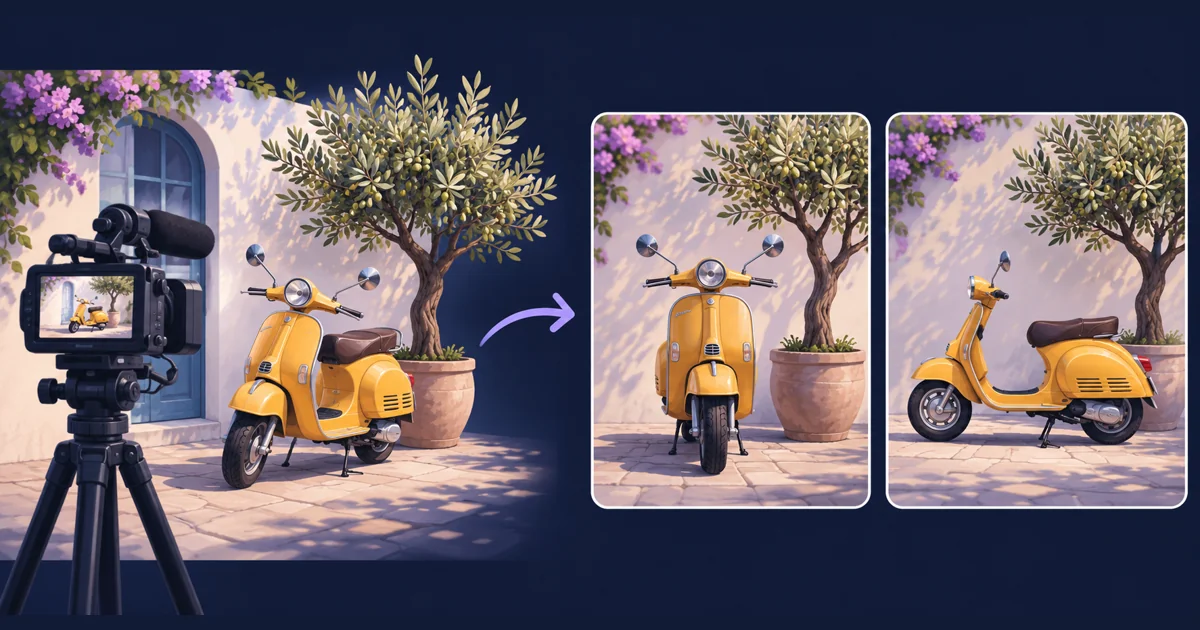
What if you could move the camera after filming? A wider crop cannot reveal the other side of a subject. Generating a genuinely different viewpoint could: turn a frontal shot into a sideways move, or explore a room beyond the original composition.
Researchers at Meta and the University of Oxford investigate that possibility with AVM, the Autoregressive View Model. Their paper, submitted on November 17, 2026, describes generating short clips along a requested camera path, using images or video as context.
How AVM changes the viewpoint
The project demonstrations show several starting points: a single image, multiple photographs, one video or synchronized recordings from several cameras. AVM produces successive views rather than first constructing a 3D model.
Camera position, orientation and scene timestamps help specify where to look and when. With moving subjects, the aim is to show the action from another viewpoint. Multiple synchronized cameras provide additional observations of the same scene.
AVM also retrieves relevant views from its inputs and earlier generations. That matters when the camera turns away and comes back: the scene should still resemble the place it left.
Research demonstrations from the AVM authors; these are not Tellers outputs.
Why this matters for video creators
We see the creative opportunity in extending a shot’s possibilities after the shoot. Potential uses include:
- Product films: exploring a camera move around a filmed object before deciding whether a physical reshoot is worthwhile.
- Music and performance videos: trying a different viewpoint for a stylized insert while keeping the original performance as the starting material.
- VFX planning: testing how a camera might travel through a location before committing to a more involved sequence.
These are directions we would explore with this kind of research, rather than demonstrated production workflows. A useful first experiment would be a short sideways move around a clearly visible subject. It poses a specific question: does the alternative angle add something worth cutting to?
New viewpoints come with new assumptions
AVM reconstructs information supported by its context and generates plausible content where observations are missing. An unseen angle is not recovered footage. For a factual property tour, for example, an invented doorway would be a problem even if the camera move looked convincing.
The paper also identifies limitations in text alignment and the amount of motion generated. Camera control does not imply that every action instruction will be followed reliably. Nor does timestamp conditioning establish a frame-accurate editing guarantee.
For a related distinction, our keyframes and reference images guide explains the different jobs visual inputs can do. Specifying a viewpoint, preserving an appearance and fixing the timing of a movement are separate creative requirements.
Once you have generated footage to work with, upload it to Tellers alongside your original clips. Ask our editing agent to build the sequence around the shots you want to keep: “Make a 20-second edit from these clips. Open with the original shot, use the alternative angle for the reveal, and finish on the product detail.”
Frequently asked questions
Where can we test AVM?
AVM is not publicly available to test yet. The authors have shared a paper and recorded demonstrations, but no public test app, API, code or model weights. Visit the official AVM project page to watch the demos and follow release updates.
Can AI change the camera angle of an existing video?
Yes. AVM demonstrates generating new viewpoints using a video as context and a requested camera path. This is novel view synthesis: it generates an alternative view, including inferred details outside the original camera’s view.
Is changing the camera angle with AI the same as cropping a video?
No. Cropping changes which existing pixels appear in the frame. A new camera angle changes perspective and can reveal surfaces the source camera never saw. That requires generating new visual information.
Does AVM create a 3D model from a video?
AVM generates a stream of 2D views without building an explicit 3D representation. Its output should not be confused with an editable mesh that you can open and relight in 3D software.