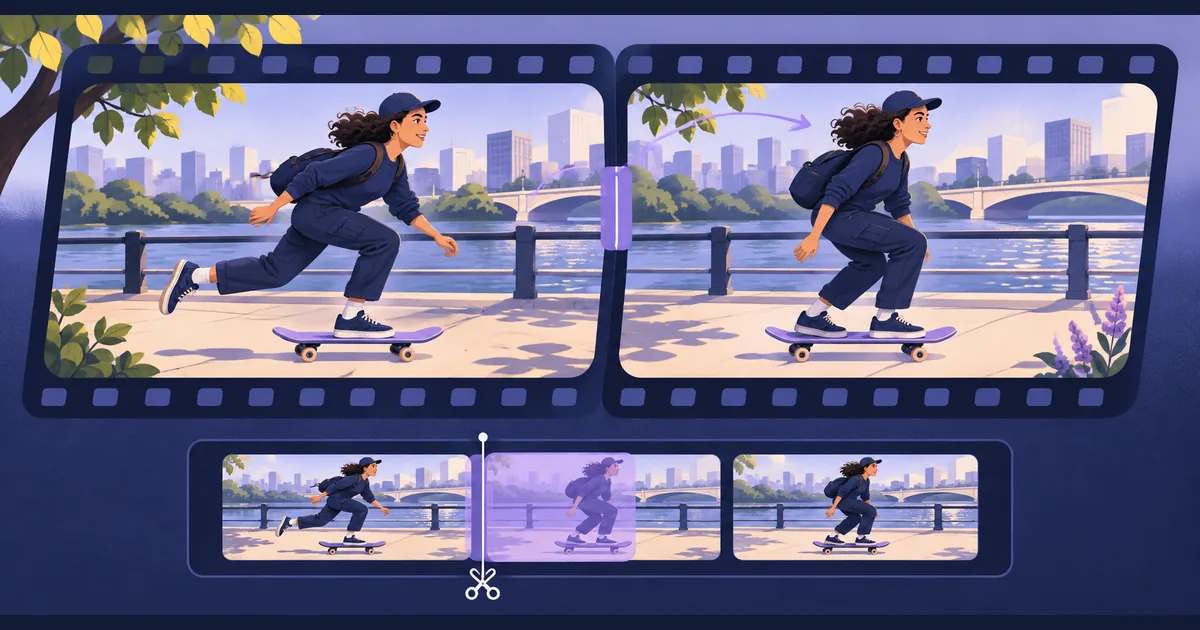
A convincing AI shot can fall apart when you try to continue it. A skateboarder slows down, a turning product changes speed, or a tracking camera restarts. The clips may match visually at the cut while the motion feels wrong.
Carrying movement across separately generated clips has been a major constraint of AI video generation. A final frame shows position and pose, but cannot uniquely describe speed, direction or acceleration. The next generation has to infer that missing history.
I call the idea Tellers Movement Anchoring: give the next clip a short history of the movement, then trim the repeated section. The input could be generated clips or recorded footage. My repeated tests with Kling 4.0 were unsuccessful: it did not place the middle frames at the requested times, so the expected overlap could not be relied on.
Tellers is an AI video editor with direct access to Kling. Each prompt below describes the full experimental workflow: our agent handles precise frame extraction, generation, compositing and timeline assembly autonomously, with live timeline updates. A bare Claude chat would need those tools connected or files passed between them; Tellers already brings them together. That simplifies running the experiment; it cannot make Kling obey timestamp instructions.
What I tested, and why it failed
I tried these source-frame combinations, where T is the last displayed frame timestamp and all offsets are in seconds:
- T−1, T
- T−2, T−1, T
- T−1, T−0.2, T
- T−0.2, T
- T−0.4, T−0.2, T
I gave Kling 4.0 explicit instructions for precise middle-frame placement and tried referring to the images as @image1 and “middle frame 1”. None of these attempts produced the timing the method needed. Kling often treated the last middle frame as the last frame of the generated video, rather than an early point to continue beyond. It also added intervening movements.
I adjusted the continuation clips after generation on separate Tellers timeline tracks. Moving a clip can align a moment, but it cannot remove extra motion inside the generated sequence. As tested, this is not a usable method for reliable movement continuity. It needs a model that follows the requested timing more precisely.
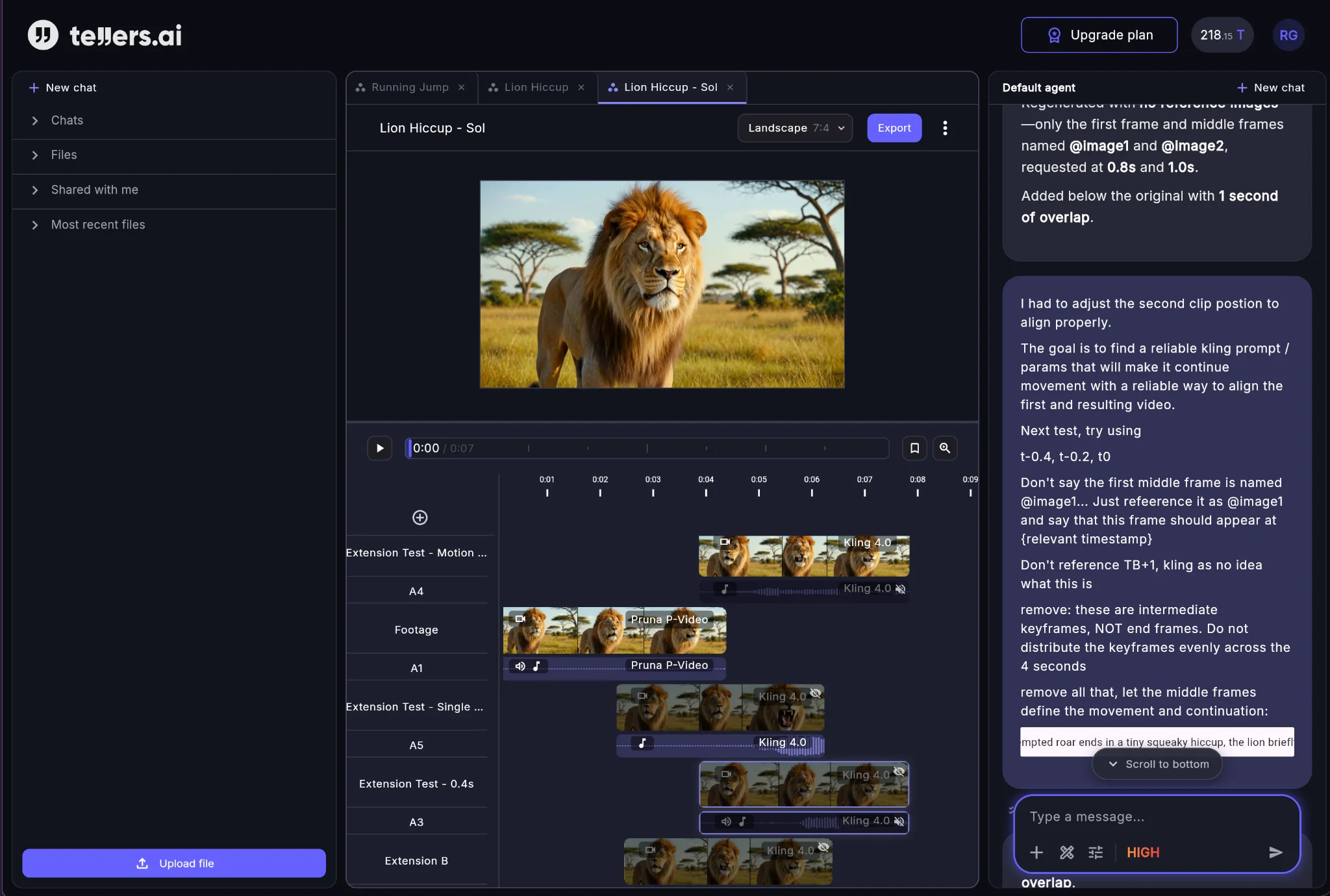
The diagrams and prompts below preserve the intended method for further investigation. The animations show the hypothesis, not a successful result. If you find a way to make Kling respect middle-frame timing more precisely, please send the prompt, settings and result to contact@tellers.ai.
We would also like to try Seedance 2.5 if it gains support for a first frame and reference images in the same generation. Its current API separates those input modes, as does Tellers. Asking a reference image to guide the opening through the prompt is possible, but does not provide a dedicated first-frame input. Combined inputs would let us test another approach; they would not by themselves establish precise timing or movement continuity.
The idea: anchor the end of the movement
Let T be the timestamp of clip A’s last displayed frame, not the file’s duration boundary. Ask Tellers to extract T−0.2 seconds and T, then use them in clip B:
| Frame from A | Role in B | Target time in B |
|---|---|---|
| T − 0.2 seconds | First frame | 0 seconds |
| T | Intermediate keyframe | 0.2 seconds |
The intention is to use T as an intermediate keyframe, leaving B room to continue beyond it, then trim B’s opening 0.2 seconds. The tests did not produce that dependable repeated opening.
Tellers extracts source frames precisely; Kling interprets target times written in the prompt. Fractional timings can be requested: the official middle-frame example includes 2.1- and 4.3-second boundaries. Our default sampling interval is delta = 0.2 seconds. This provides closer motion samples, not a promise of 0.2-second accuracy from Kling. In my tests, timing failed even with explicit instructions. Mostly continuous motion was the intended starting point, but it did not establish a reliable solution.
Generate an 8-second Kling 4.0 clip A: a skateboarder rolls left
to right along a riverside path, with the camera tracking alongside.
Keep the final second at a steady speed, with no cut, pause or fade.

Apply Tellers Movement Anchoring. Let T be the timestamp of A's
last displayed frame. Extract the frames at T-0.2 seconds and T.
Generate an 8-second Kling 4.0 clip B using the earlier image as
its first frame at 0 seconds and A's last image as an intermediate
keyframe targeted at 0.2 seconds. Continue the same movement,
camera direction and lighting after that point. No stop or restart.

Assemble A then B on the timeline. Trim B's repeated opening 0.2 seconds,
adjusting the cut to the actual matching action if needed. Smooth
the audio join and show the result in the live timeline.
Open the two-frame experiment in Tellers
Give Kling more movement history
Set N to the total number of frames and delta to the interval between them. The defaults, N = 4 and delta = 0.2 seconds, sample T−0.6, T−0.4, T−0.2 and T and target 0, 0.2, 0.4 and 0.6 seconds in B.
The overlap is L = (N−1) × delta. Choose N from 2 to 9 and a positive delta, with enough source footage and room for the continuation within our Kling 4.0 limits. Changing delta changes the sampled history and prompt targets, not the precision with which Kling follows them. Source sampling uses the nearest available frame.
Set N and delta on the first two lines:
N = 4 total sampled frames, including the final frame.
delta = 0.2 seconds between sampled frames.

Apply Tellers Movement Anchoring to my selected video.
Let T be its last displayed frame timestamp and L = (N-1)*delta.
Extract N frames, delta seconds apart, from T-L through T in
chronological order. Use the nearest available source frame
for each time. For N=4 and delta=0.2, sample T-0.6, T-0.4, T-0.2 and T.

Generate a Kling 4.0 continuation with duration L+5 seconds,
rounded up to a whole second. Use 2<=N<=9 and delta>0. If there
is insufficient source history or the duration exceeds 30 seconds,
ask me to adjust the parameters before generating.
Use the earliest image as the first frame at 0 seconds and the
remaining images as intermediate keyframes targeted at delta,
2*delta, ... L seconds in the prompt. Do not use T as B's final
frame. Recreate the overlap, then continue the same motion for
at least five seconds, preserving appearance, direction and light.

Assemble the original through T followed by the continuation.
Trim B's opening L seconds, adjusting to the actual matching
action if needed. Smooth the audio join and show the live timeline.
Run the full workflow from this prompt.
Open the configurable experiment in Tellers
Potential application: real footage into AI VFX
Clip A could be footage you filmed. The following is a potential application of the same unproven method, not a demonstrated VFX workflow. The prompt below inspects your actual video rather than assuming a scene. It defaults to N = 2, delta = 0.2 seconds, sampling T−0.4 and T−0.2. The intended edit hands off at T−0.2, leaving the final 0.2 seconds of source footage out of the assembled sequence; the original asset stays intact. To retain the source all the way to T, use the preceding prompt instead.
Add your desired effect separately, starting after the overlap. For example:
- Impossible-world reveal: continue a filmed camera push through a doorway into a crystal cavern or futuristic city.
- Product transformation: continue a real shoe or bottle rotating, then let it dissolve into particles or reveal a glowing interior.
- Fantasy action: continue a performer’s reach or staff swing, then add an energy trail along the same direction.
Choose a clear handoff. Heavy blur or occlusion obscures motion, and generated faces, lettering or product details can still drift. A generated continuation creates new imagery; it does not preserve every pixel of the filmed subject. These use cases still depend on solving the timing problem described above.
N = 2 total sampled frames.
delta = 0.2 seconds between sampled frames.

Apply Tellers Movement Anchoring to my selected uploaded video.
Inspect the footage to identify its actual subject, setting and
movement. Do not assume a source scene or add an unrequested effect.
Let T be its last displayed frame timestamp. Extract N frames from
T-N*delta through T-delta, delta seconds apart, in chronological
order. With the defaults, use only T-0.4 and T-0.2 seconds.

Set the handoff H = T-delta and overlap L = (N-1)*delta.
Generate a Kling 4.0 continuation lasting L+5 seconds, rounded up
to a whole second. Use 2<=N<=9 and delta>0. If source history is
insufficient or duration exceeds 30 seconds, ask me to adjust them.
Use the earliest image as the first frame at 0 seconds and the
remaining images as intermediate keyframes targeted at delta,
2*delta, ... L seconds in the prompt. Recreate the incoming motion,
then continue it naturally. Apply VFX after the handoff only if
I have specified an effect separately.

In the edit, keep the original through H, leaving its later footage
out of the assembled sequence without deleting the source asset.
Append the generated clip after trimming its opening L seconds;
adjust the cut to the actual matching action if needed. Smooth
the audio join and show the result in the live timeline.
Open the real-footage experiment in Tellers
Has this idea been explored before?
The broader principle has prior art. SparseCtrl (2023) demonstrated prediction from several starting frames. StreamingT2V, first submitted in March 2024, uses information from preceding video chunks to improve continuity. These research methods differ from this Kling editing recipe.
Our search did not identify an earlier description of this exact sparse-keyframe-and-trim workflow for Kling. That does not establish a first invention; Tellers Movement Anchoring names the experiment described here.
Until generated timing becomes more dependable, treat these prompts as experiments rather than a production shortcut. If your tests succeed, contact us with enough detail to reproduce the result. For the input roles behind the technique, read our keyframes vs reference images and first/last frames guide.
Frequently asked questions
Can Seedance 2.5 use a first frame and reference images in the same generation?
Not as combined input types: Seedance 2.5 currently separates first/last-frame mode from reference mode, including on Tellers. You can ask for a reference image to guide the opening in the prompt, but that is not a dedicated first-frame input. If combined inputs become available, we can test Movement Anchoring with Seedance 2.5; precise timing would still need validation.
What is Tellers Movement Anchoring?
It is an experimental workflow: sample the end of a video, reuse those images as early keyframes in a continuation, then trim the intended overlap. Our Kling 4.0 tests were unsuccessful because the model did not follow the requested timing and introduced extra movement.
Can we define precise timestamps for Kling keyframes?
Target times must be given in the Kling prompt; there is no separate precise placement control for middle frames on Tellers. Fractional times can be requested, but Kling did not respect them precisely in our Movement Anchoring tests. It often treated the last middle image as the generated ending and added intervening movement. Precise source-frame extraction does not make generated timing precise.
Did any sampling interval make Movement Anchoring work reliably?
No. Robin tried five patterns using one-second, two-second and fractional offsets, including T-0.4, T-0.2 and T. None delivered the reliable keyframe timing and motion continuity required by this method.
Can I continue a real video with AI using its last frames?
Real footage can supply the sampled images, but we have not established a reliable continuation method with Kling 4.0. The retained real-footage prompt is an experiment, not a working VFX recipe. Its intended handoff is T-0.2 with the default settings; the generated match may not occur there.