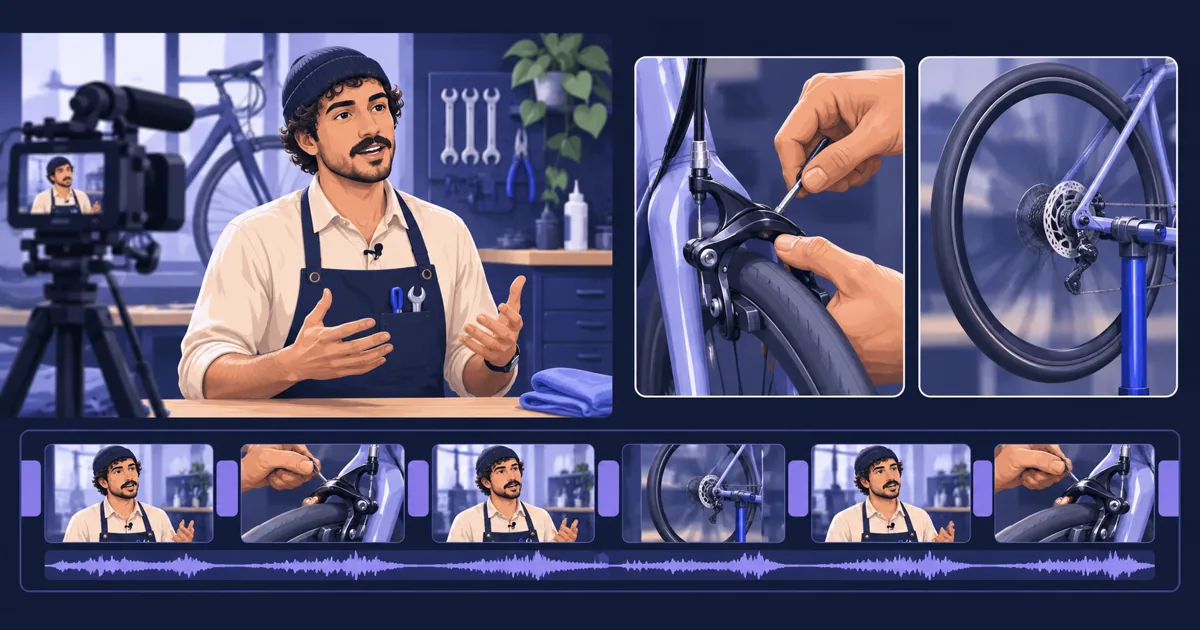
To add B-roll to an interview with AI, ask the editing agent to match supporting shots to specific spoken passages, then place those pictures over the original dialogue. The aim is to help viewers understand what the person means while keeping their voice and story intact.
Start with an interview sequence whose structure already works. Our interview rough-cut guide covers choosing and assembling the answers. This next pass decides what the audience should see while those answers play.
Give each supporting shot a job
B-roll can establish a location, explain a process or cover a distracting picture jump. Lehigh University’s videography guidance similarly treats it as visual context for the narrative, with a mix of wide shots and details.
Imagine a bicycle mechanic describing how the workshop diagnoses a problem. A wide workshop shot establishes the place. Hands adjusting a brake show the work. A wheel spinning on a repair stand shows the check afterwards. Three useful images tell us more than three unrelated shots containing bicycles.
Match the action to the meaning of the sentence. Footage of a finished bicycle does little to explain a tricky adjustment. Equally, a close-up of a different component can mislead viewers who are trying to follow the explanation.
Keep the person on screen when their expression matters. A smile after recalling a first customer, or a pause before discussing a mistake, may be the strongest picture you have.
Ask for a short coverage plan
Upload the interview and supporting footage with clear filenames. Separate different locations or filming days so the agent has useful context. In Tellers, our agent can analyse footage, read transcripts and edit the timeline. You can direct the whole B-roll pass by prompting.
Before changing the cut, ask for a few proposed matches:
Review this interview rough cut and the supplied workshop footage.
Propose B-roll for the passages about diagnosing a brake problem,
making the adjustment and checking the result.

For each suggestion, give the interview passage, supporting source
filename and time range, and what the shot helps the viewer understand.
Use only supplied footage. Flag gaps instead of filling them with
loosely related images. Keep the speaker visible for personal reflections.
Wait for my selection before editing.
Review the actual source clips alongside the proposal. A description might identify the right object while missing that the action is obscured, out of focus or unfinished. Choose a moment with a readable beginning and end, rather than a fragment that cuts away just as the useful action starts.
Add the pictures without disturbing the voice
Once you have chosen the shots, give the agent a bounded edit:
Add the approved B-roll to a new version of the interview timeline.
Keep the interview audio, dialogue timing and total duration unchanged.
Place the repair close-ups over the matching explanation, and use
the workshop wide shot where the location is introduced.

Mute distracting camera audio from the B-roll. Return to the speaker
for the personal reflection. Do not add music or generated footage.
Show me the playable version for review.
If you are covering a jump between interview takes, start the B-roll before the picture jumps and return after it. Avoid cutting away and back for only a fleeting instant. Let the viewer register the action without holding an image long after it stops adding information.
Natural workshop sound can make a sequence feel grounded, but it should not compete with speech. Add it deliberately after the picture choices work; an accidental burst of camera audio can distract from an otherwise clean edit.
Review meaning as well as continuity
Watch once for the story and once for the joins. Does each shot belong to the place, person and process being discussed? Does a cut imply a result that the interview never claims? Does the return to the speaker feel natural?
Give revisions by purpose: “show the brake adjustment during the explanation, then return before the reflection” is clearer than “add more variety.” That is vibe editing with an editorial intention the agent can act on.
When coverage is missing, staying on the speaker is often the strongest choice. Open Tellers and start with a small coverage plan you can review.
Frequently asked questions
Should B-roll replace the interview audio?
Usually, keep the interview voice running underneath the supporting picture. Bring in location sound when it adds useful detail, at a level that leaves every word clear.
What if I have no suitable B-roll for a passage?
Stay on the speaker, shorten the passage if it repeats an idea, or plan a specific pickup shot. Stock or generated imagery can illustrate a concept, but should not imply that an unrecorded event actually happened.