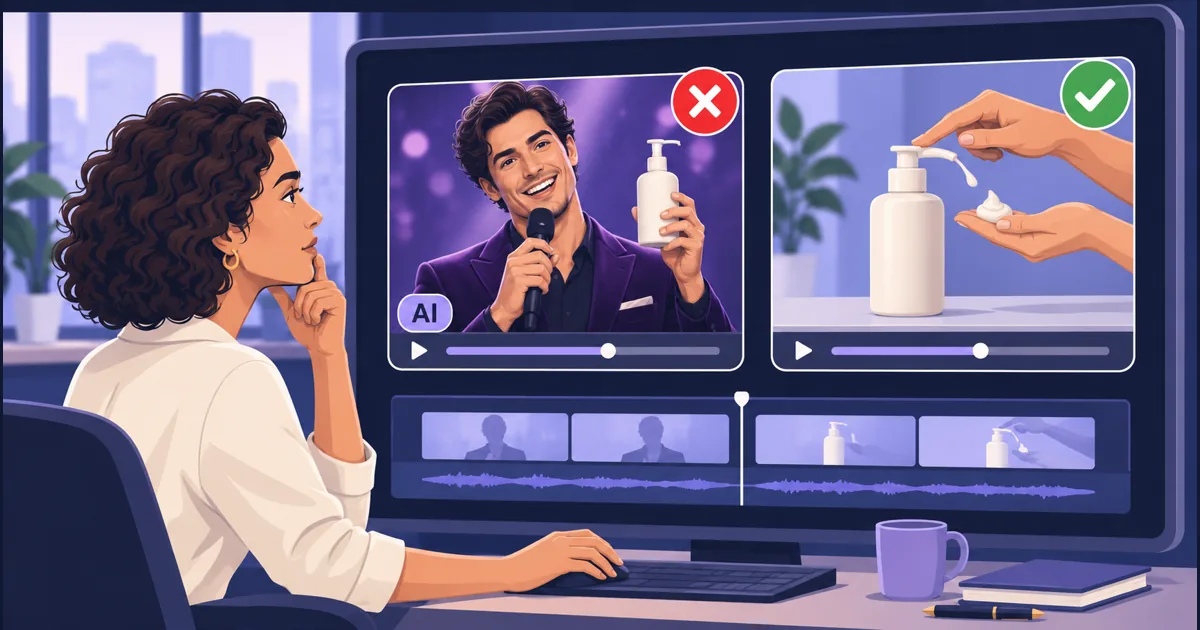
An AI label does not make a fabricated celebrity endorsement acceptable in Google Ads. In a clarification posted on November 11, 2026, Google explicitly says its public-figure impersonation prohibition still applies when an ad discloses that it was generated or edited with AI.
This is a platform-policy clarification, not a new law or a new grace period. Google says enforcement has not changed. For teams creating marketing videos with AI, the practical consequence belongs in the brief: decide whose identity and endorsement you are entitled to represent before generating the shot.
Disclosure and endorsement answer different questions
A label describes how a video was made. It does not establish that the person shown recommends the product.
Google’s public-figure impersonation policy covers deceptive uses of well-known people, including entertainers, athletes, influencers and business figures. It gives AI-generated videos of popular YouTubers falsely endorsing a get-rich-quick scheme as an example. Google treats violations as egregious and says accounts can be suspended upon detection without prior warning.
The same policy recommends documented consent and accurate claims. Keep evidence of a genuine partnership with the production brief, including what the person has agreed to say or endorse. Permission to use a photograph should not be treated as permission to invent a new recommendation.
Change the creative idea, not just the label
Suppose an ad concept depends on a recognisable presenter apparently praising a product they have never endorsed. Adding “AI-generated” leaves the core problem intact. A more useful revision is to replace that premise with a demonstration viewers can evaluate themselves.
For a skincare dispenser, show the packaging, the pump action and the amount dispensed. Use approved product claims in text or narration. If the campaign needs a testimonial, use an authentic, authorised statement and keep its meaning intact through the edit.
The same review applies to voice. Removing a famous face while retaining an imitation voice and language suggesting a personal endorsement may preserve the misleading impression. Judge the full combination of picture, sound, captions and destination page.
Put the boundary into your Tellers brief
We support editing real footage and generating assets in the same workflow. That makes a clear creative boundary useful before the first cut:
Create a 20-second product demonstration from these approved clips.
Show the packaging, pump action and product texture.
Use only the claims in the attached approved copy.

Do not imitate a public figure's face or voice, or invent a testimonial.
Flag any source clip or line that suggests an endorsement not documented
in the brief. Show me the rough cut for review before final export.
Review the result as a viewer who has not read the brief. Who appears to be speaking? What relationship does the ad imply? Does the landing page reinforce an unsupported claim? These questions help catch a misleading impression that a production label cannot fix.
Our customer testimonial editing guide covers working with real interview material. When the message is ready, build the product-led cut in Tellers. Editing assistance supports that review; it does not guarantee an advertising platform’s approval.
Frequently asked questions
Does an AI-generated label make a fake endorsement acceptable?
No. Google’s November 11 clarification explicitly says disclosure does not make AI public-figure impersonation acceptable under its advertising policy.
Is this a new law or a new enforcement deadline?
Neither. This is a Google Ads policy clarification posted on November 11, 2026. Google says it does not change enforcement; the notice introduces no new compliance deadline.